Sunday, August 29, 2021

Back to School 2021-2022!

 Hello Students!  First of all, I want to apologize for not further updating this site!  I realized that I said I would give you instructions about the Internal Assessment and I did not.  

We will be meeting back in the classroom this Thursday 9/2/21 since all my 3-4 classes are on B days.  It will be great to see those of you that I taught last year and to meet the students who had Ms. Lisensky.  About a month ago, I was assuming that this school year would be pretty normal, but with the recent surge of the Delta variant, we will just have to see.  I am hopeful that it won't make many inroads into our school since most of us are vaccinated and we are good at wearing masks.  But if there is one thing COVID has taught us, it is that we can't get too comfortable with how we think it behaves.  I'm all about getting back to some normalcy and learning this fantastic biology curriculum in-person, but the safety of all of us and our families needs to be front and center as well.  I will do my best to communicate with you and keep teaching biology regardless of what happens, and hopefully we will be mostly in-person.

Many of you may be wondering about the summer work.  I will have you submit it through Canvas once I get that site going, but I will spread that out over the first 2 months.  I would like you to do your first science article and submit it by Friday, 9/10.  That way I can give you some feedback before you do the second one.  I will have you submit the review in pieces so that it doesn't all have to be done at once.  Finally, I will talk to you a little about the Internal Assessment in the first 2 weeks of class, but I will give you the "official" information about it in early October.  I'm sorry if you have been stressing about this work all summer and now you see that you have more time.  But if you already did it all, that is fantastic because you can put your energy towards other assignments and tasks.  

Tomorrow I plan to work a lot on my Canvas pages and possibly even get yours published.  It will probably have a message like this one and some of the early documents that we will be using.  If you have any questions, feel free to send me an email at mkenny@pps.net.

I am so excited to get this year started and meet all of you!

Tuesday, June 8, 2021

Welcome to the Summer Class Website for IB Biology HL 3-4!

 Welcome to Ms. Lisensky's students and hello to the students I taught this last year!  I'm directing you to this blog because I don't think that Canvas will be available all summer.  This is one of the sites that I have used for my class over the years, so you can look back at previous entries if you would like.  I will be updating this site so that it is more tailored to your needs this summer.  I will be adding textbook sections and resources that are applicable to what I will be asking you to do.

Higher Level IB Biology is a very dense course with lots to learn.  I always feel like the 2nd year is a constant sprint just to keep up, and this year might seem especially busy because we missed so much of the valuable in-person work that we typically do.  At the same time, IB has adjusted their expectations for the coming year by cutting out the usual option and removing one of the tests (Paper 3), which is good.    With smart planning, perseverance on your part, and the inherently interesting curriculum, I expect that this coming year will be challenging, engaging, and rewarding.

I am going to be asking you to do 3 things this summer to help review this past year and prepare for next year.  They are:

  1. A Personal Review Guide of the Chapters that we have covered (1, 2, 3, 7, 9, and 10)
  2. Written Reviews of 2 Current Biology-Related Scientific Journal Articles (at least 1 of them should have strong connections to a topic we covered during the first year)
  3. Preparation for the Internal Assessment Lab Investigation
In addition, there are some excellent biology-related popular books that you can read and review as an extra assignment (not extra credit, but could potentially replace a future assignment).   

Each of these items will be explained in more depth in a document that I am currently developing.  In addition, I will be adding supporting documents and links on this site that should be able to help you with your summer work.  In addition, feel free to email me at any time this summer.  It may take me a few days to get back to you, but I will be around for most of the summer.  My email:  mkenny@pps.net

Monday, June 8, 2020

What We Have Covered, What We Will Cover, and Suggested Summer Work

Hello students who are taking IB Biology HL 3-4 this coming Fall!  I want to welcome Ms. Cameron's students to this site and the students who I taught last year.  As I learn more over the summer about school, I will probably update this site, but for now, I want to give you an idea of what we will cover and some suggested assignments to do before the Fall.  These assignments include the Enzyme Worksheet, Ecology Worksheet Part I, and Ecology Worksheet Part II.  All 3 of these documents are in the list to the right of this blog.  You will also find the relevant sections from the textbook and my notes on Ecology.

Here is a link to what we covered last year and will cover next year.  I hope that you enjoy your summer, get outside and immerse yourself in nature, and take some time to learn or review some biology.

Saturday, April 11, 2020

Please Start Using Google Classroom for Information about Assignments!

Hi Students!  I know I have told you to go to this site for the whole year, but I think it will be easier for me to put information on Google Classroom now to do online education.  You can still come to this site for information from documents, but I am going to try to migrate all of my instructions over to Google Classroom.  Please be patient as this might take a few weeks.  Currently I have an assignment on Google Classroom about the Genetic Code Worksheet.  In the instructions for that assignment I have put 4 videos (2 of me talking with my notes and 2 from other sources), the Transcription Notes, and the 7.2 Section from the text.

Thursday, March 26, 2020

A Chick Video!

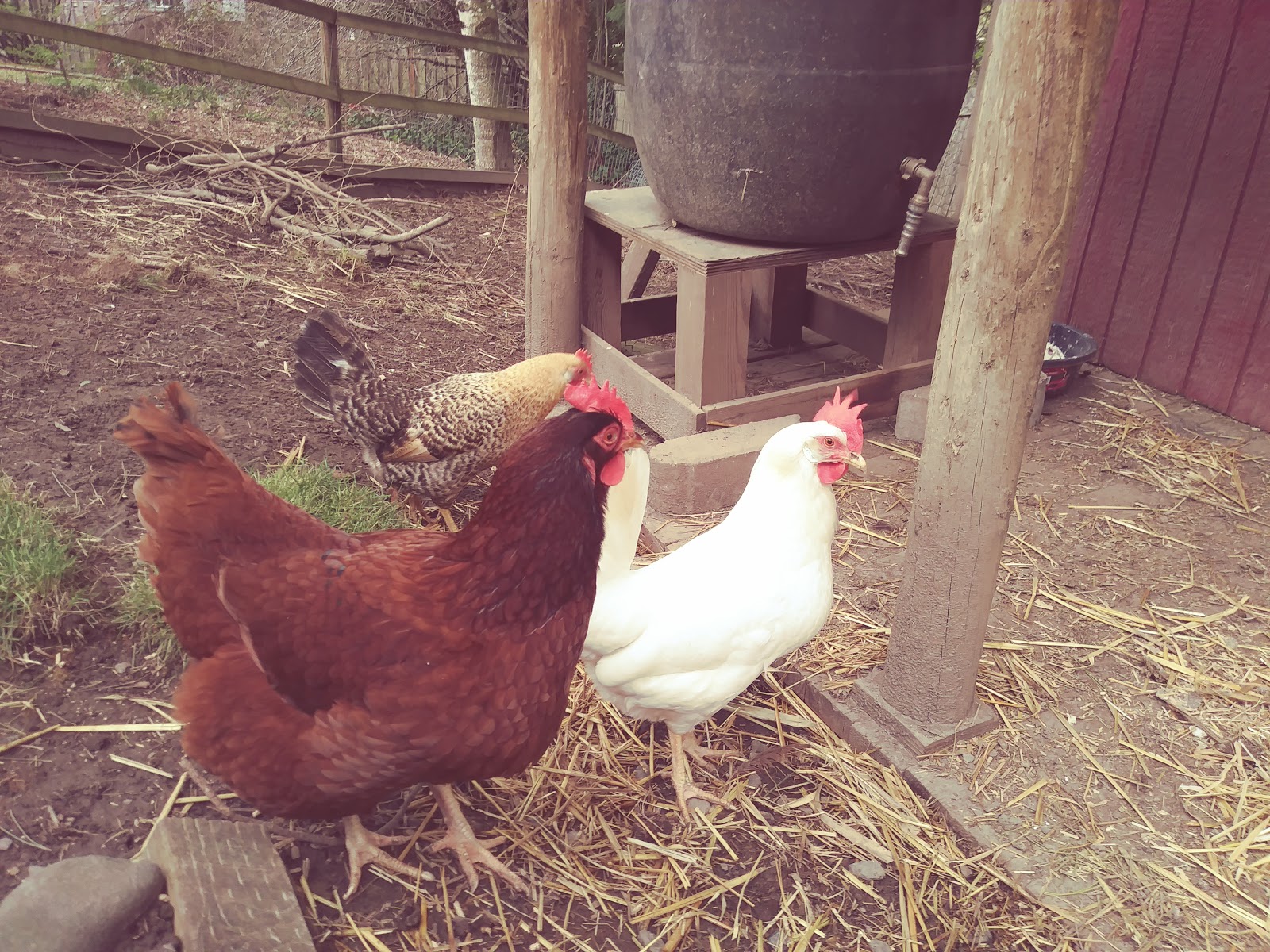
Hi Students!  I've been grading IA's for 2nd year and it's driving me bananas, so here is a video of the growing chicks.  Listen to their cute little peeps!  Their grown up sisters are squawking in the background.  I'll include a photo of them too, so you can see where all the noise is coming from.  Apparently I was supposed to be paying more attention to them!  Hope you all are hanging in there!


The older girls:


Friday, March 20, 2020

Video Update for March 20, 2020

Good Morning Students!  Here is today's video.  In brief, what it says it to keep those 2.7 and 7.1 questions coming in, but you can forget the 2-3 paragraph response (I know that I said 2-3 pages by accident in my video!) to the epigenetics video and the dbq's.  Stay tuned for some instructional videos on Transcription and Translation.  Also, I said that we got 18 chicks, but it is actually 16, and they are so cute!  Photo included below.


Baby Chicks!


Wednesday, March 18, 2020

Hi Students! First Video

Hello Students:

My first video to you is below.  In summary:

  1. Review DNA Replication (notes and some videos are on my website
  2. Finish 2.7 and 7.1 Questions in your notebook and email me a photo (mkenny@pps.net)
  3. Read 7.2 and go over Transcription Notes
  4. Watch "Epigenetics the Hidden Life of Our Genes" and the 8 minute clip from "Ghost in our Genes" .  Write a 2-3 paragraph summary of what you learned about epigenetics and how it relates to transcription.  
  5. Do DBQs on pp 356 and 358 in 7.2.  You can put the answers at the end of your 2-3 paragraph document.  Submit both the paragraphs and dbqs to the assignment in turnitin.com by Friday 3/20
  6. Read the transcription and translation sections of 2.7.   I will put a genetic code worksheet on the website to work on.

Monday, March 16, 2020

Update of What We Have Covered and Will Cover


  • Tues 3/10:  Science State Testing.  Thank you all for being so cooperative with this!  I'm not sure how this will get finished in light of corona virus, but I'm assuming that extensions will be made and you will be pulled out to finish it later when we get back to school.
  • Thurs 3/12:  Go over the Hershey-Chase experiment and notes on DNA Replication.  Work on the 7.1 questions that I put on the website.  Get checked off when you finish.
  • Mon 3/16:  Review DNA replication.  I have put several videos on this website to help you go over the process.  Finish doing the 2.7 and 7.1 questions in your notes.  You can email me a photo of this work and I will check it off.  Read 7.2 and go over the Transcription Notes.  
  • Wed 3/18:  Watch the Video "Epigenetics: The Hidden Life of our Genes".  It is 53 minutes.  We used to show "Ghost in Your Genes" as the primary video on epigenetics and I have also included an 8 minute clip of that.  Please watch these and write 2-3 paragraphs about how epigenetics works and how it relates to the topic of transcription.  I would also like you to include answers to the 2 DBQs in 7.2 on twin studies.  Please submit these to turnitin.com by Friday 3/20!
  • Fri 3/20:  Read the transcription and translation sections of 2.7 (pp 116-122) and do the Genetic Code worksheet on my website.   I will post a video to help you get started on this.  
  • Moving forward:  Read 7.3 and go through the Translation Notes.  I will post videos to help with this material.

Friday, March 6, 2020

2.7 and 7.1 Work to be Done after the Genetics Test on Friday 3/6

  1. (Starting in 2.7) What does it mean to say the DNA replication is semi-conservative?
  2. Read the section on the Meselson-Stahl experiment, describe the evidence, and explain what it means.
  3. Do the DBQ on pp 113-114
  4. What does helicase do?
  5. What does DNA polymerase do?
  6. (Moving to 7.1)  What were Hershey and Chase trying to determine in their experiment?
  7. Outline the Hershey-Chase experiment, including the results.
  8. What is a nucleosome and what is its role in DNA packing?
  9. Do the DBQ on p. 349 (this one is tricky, but I will give some background on it in class)
  10. Outline the process of DNA replication.  You may draw a diagram.  (We will go over this in class).
  11. What direction does DNA replication go and why is it limited in this way?
  12. What are some of the functions of non-coding DNA?

Monday, February 17, 2020

Genetics Unit


  • Tues 2/18:  Notes on basic genetics, how to do a monohybrid cross with simple dominance and co-dominance.  ABO blood group crosses.  Dihybrid crosses and the multiplication rule.  Work on the Old Book Genetics Problems (you can skip #6 for now).  Do problems on separate paper that you can turn in.  Show work and/or explain reasoning.  Work can include Punnett grids, diagrams, and showing mathematical work.  Read 3.4 if not already.
  • Thurs 2/20:  Go over some of the genetics problems and introduce pedigrees.  Sex-linked genes.   More work time on genetics problems, to be turned in on Monday 2/24.  Hand out pedigree worksheet.  Start reading 10.2.
  • Mon 2/24:  Turn in genetics problems.  Check off pedigree worksheet.  Notes on causes of genetic diseases and some common single gene disorders.  Polygenic inheritance.  Genetics of Race Video.  Research a single-gene disorder, including where on the chromosomes it occurs, what it does to impact the body, symptoms, treatments, outcomes, interesting facts, etc.  
  • Wed 2/26:  Notes on linked genes, recombinants, calculating frequencies of recombination, and a little bit on gene mapping.  Introduce chi-squared.  Some DBQs to be done in your notebook:  pp. 452-453 and p. 454 (chi-squared).
  • Fri 2/28:  Chi-squared and flower activity.  Answer questions in pairs and get checked off..  Read 10.2 if not already.  Review for Genetics Test to be taken next Friday 3/6.
  • Tues 3/3:  Counselors will be here to do a 30 minute presentation.  Play Kahoot Review for Genetics Test.
  • Wed 3/4:  SAT Testing Day.  There will be a Full 8 schedule for those not taking the test.
  • Friday 3/6:  Genetics Test.  Start replication.  Read the first part of 2.7 and 7.1.

Thursday, February 6, 2020

What's On the Meiosis and Genes Short Test on Thursday, February 13?

  • Be able to describe all the phases of meiosis, in particular, make sure you understand the difference between Meiosis I and Meiosis II
  • Be able to identify phases of meiosis in simple diagrams or pictures
  • Be able to draw and label the stages of crossing over making clear the before, during, and after.  I recommend 4 stages as they showed in the book in 10.1.  Be able to distinguish between homologous chromosomes, sister chromatids, and nonsister chromatids.
  • Be able to describe the significance of independent assortment and how it adds to the variety of gametes.
  • Basic vocabulary involving genes and chromosomes.  In addition you should be able to distinguish between genes, chromosomes, and genomes
  • Be able to describe how nondisjunction occurs and be able to describe two disorders caused by nondisjunction
  • Be able to discuss the 2 methods of obtaining fetal cells for karyograms, including how they are done, benefits, and risks.

Wednesday, January 29, 2020

The First Few Weeks of the 2nd Semester!


  • Tues 1/28:  Hand back Semester Final Exams, check them over, and recollect.  Introduction to what we will cover this semester.  Notes on meiosis, how it is different from mitosis, and the 8 phases.  Do first side of meiosis worksheet, identifying the phases.  Read 3.3.
  • Thurs 1/30:  Notes on the Higher Level meiosis.  Synapsis and crossing over.  Do the "creature" activity on the back side of the meiosis worksheet.  Using 2 cards, determine the genotypes and phenotypes of your creature family and then draw a family portrait with your table group.  Read 10.1 (higher level meiosis).
  • Mon 2/3:  Notes on genes, mutations, gene mapping, the Human Genome Project, etc.  Finish the Family Portrait if necessary.  Read 3.1.
  • Wed 2/5:  Notes on chromosomes, plasmids, genome sizes, and chromosome numbers.  Do DBQ's on pp. 153, 156, and 159 in your notebook.  Read 3.2.
  • Fri 2/7:  Karyograms and nondisjunction.  Check off DBQ's and go over them.  Wrap up the unit.
  • Tues 2/11:  Review Meiosis and Genes and play Kahoot for Short Test to be taken on Thursday.  If time, start Genetics.
  • Thurs 2/13:  Short Meiosis and Genes Test.  Introduce Mendel and the principles of inheritance.  Start reading 3.4.

Tuesday, January 28, 2020

What Are We Doing Second Semester??

Here are the topics and syllabus sections for 2nd semester:

  1. Meiosis and Genetics:  3.3, 10.1, 3.1, 3.2
  2. Genetics:  3.4, 10.2
  3. Replication, Transcription, and Translation:  2.7, 7.1, 7.2, 7.3
  4. Enzymes:  2.5, 8.1
  5. Biotechnology:  3.5 and a few other sections
  6. Plants:  9.1, 9.2, 9.3, 9.4

Sunday, January 12, 2020

What's On That Cell Cycle Quiz on Tuesday 1/14?


  • Be able to outline the events of the cell cycle, starting with interphase (include all 3 parts of interphase) and ending with cytokinesis.  Be thorough!
  • Be able to distinguish between cell division in prokaryotes and eukaryotes, including why these differences are necessary
  • Be able to distinguish between cell division in plant cells and animal cells, including why these differences are necessary
  • Be able to describe several things that you see in an indicated cell in an onion root tip slide and determine which phase of mitosis it is (we are including interphase, even though it officially isn't a phase of mitosis).

Sunday, January 5, 2020

Welcome Back to IB Biology in 2020!!

It's 2020 and we're almost done with the First Semester of IB Biology!  Are you excited!!?  We are going to cover a short unit on Cell Division, Finish Photosynthesis by doing a Chromatography Lab, and review for the Semester Exam.  Remember that you can still put together a Book Group, but you have to do it quickly because your meeting and book review must be done by Friday 1/17/20!


  • Mon 1/6/2020:  Overview of mitosis and the cell cycle.  At your tables, practice simulating cell division using string and yarn.  
  • Wed 1/8/2020:  Onion Root Tip Mitosis.  Finish cell division simulations.  Cell division and cancer.  Quiz on cell division next Tuesday 1/14.  
  • Fri 1/10/20:  Chromatography Lab.  Turn in today if complete or next Tuesday.
  • Tues 1/14/20:  Cell Division Quiz.  Turn in Chromatography Lab if not already.  Start reviewing for semester exam.
  • Thur 1/16/20:  Review for semester exam.  Play Kahoot!
  • Fri 1/17/20:  Deadline for Extra Credit and Late Work is today!  Book reviews and SPARK lecture reviews need to be submitted through turnitin.com
  • Mon 1/20/20:  Martin Luther King Day:  No School
  • Tues 1/21/20:  Full Eight Schedule:  Last minute review and check in on your grade prior to the semester exam.
  • Wed 1/22:  Final Exams:  1, 2, 4
  • Thur 1/23:  Final Exams:  5, 6, 8
  • Fri 1/24:  Final Exams:  3, 7, Makeup Exams (done through excused prearrangement only)

Tuesday, December 17, 2019

Cell Respiration and Photosynthesis Test This Thursday 12/19

Make sure that you look over the review sheet on this website and the Kahoot to help prepare for this test.  The test will be made up of the following:

  1. 20 multiple choice questions (1 pt each for 20 pts total)
  2. Draw and clearly label 7 parts on either a mitochondrion or a chloroplast.  You don't get to choose.  Your test will tell you which to do.  (6 pts)
  3. Explain how structure supports function for at least 3 structures in the drawing from 2. above (4 pts)
  4. Pick 2 out of 3 short answer questions (4 pts each for a total of 8 pts)
  5. Pick 1 out of 2 longer answer questions on processes in cell resp. and photosynthesis (8 pts)
  6. A graph related to our topic with 4-5 short data-based questions associated with it (6 pts total)
Total points:  52

Sunday, December 1, 2019

Now Until Winter Break


Hello Students!  The cell respiration and photosynthesis unit is typically one of the most challenging units and we will be covering it between now and Winter Break.  I highly recommend that you get ahead of the material by reading through the sections: 2.8, 8.2, 2.9, and 8.3.  I also recommend watching videos such as the Crash Course ones I have posted and others like Khan Academy.  The repetition and hearing explanations from different perspectives can really help!  The more you let the material into your brain, the more likely your brain will be to accept it and not fight it.  Start now and revisit the material regularly!  Your brain and your stress level will thank you.  But also remember to get some exercise, listen to good music, eat healthy food, and get some sleep!

  • Tuesday 12/3:  Review glycolysis and the link reaction and give more details on the Krebs Cycle.  Crash Course video on Cellular Respiration.  The electron transport chain and chemiosmosis.  Respirometers.  Read 8.2 really well!
  • Thurs 12/5:  Seed Germination Respiration Lab.  Take data and answer the questions for Parts I and II.   Read 2.9.
  • Mon 12/9:  Do Part III of Respiration Lab.  Complete and turn in today or Wednesday.  Overview of Photosynthesis.  Action and absorption spectra.   
  • Wed 12/11:  Photosystems II and I.  Overview of the Calvin Cycle.  Read 8.3 if not already.
  • Fri 12/13: .  Review all parts of photosynthesis.  Drawing and labeling mitochondria and chloroplasts. Coloring sheet for chloroplasts and mitochondria.  Cell Respiration and Photosynthesis test next Thursday 12/19.
  • Tues 12/17:  Review for Cell Respiration Test and Photosynthesis.  Play Kahoot.
  • Thurs 12/19:  Cell Respiration and Photosynthesis Test.  Pick up Hand-Out on Cell Division when done and get it started.

Wednesday, November 20, 2019

2.8 Work to be done after the Biochemistry Test on Wednesday, November 20

Please Do The Following in your Notebook.  To be checked off towards the end of the period on Friday, 11/22.


  1. Define cell respiration.
  2. What is ATP and what is its advantage for cells?  What is it used for in the cell?
  3. Why do cells need a continual supply of ATP?
  4. What is anaerobic respiration?  Where/when does it occur?
  5. List the 2 summary equations for anaerobic respiration (animals, and yeast and plants).
  6. Discuss bread making and bioethanol as examples of anaerobic respiration.
  7. Do the data-based questions on p. 125.
  8. Discuss anaerobic respiration in humans.
  9. Write the equation for aerobic respiration and state its differences from anaerobic respiration (at least 3).

Monday, November 11, 2019

The Two Weeks Before Conferences


  • Tues 11/12:  Link together the monomers that you made out of clay last week.  Some notes on proteins and nucleic acids.  Make nucleic acids out of beads.  If time, do DBQ on Chargaff's Rules on p. 107 of the book.
  • Thurs 11/14:   The structure of DNA.  Finish DBQ on p. 107 and get it checked off.  Start reviewing for Biochemistry test to be taken next Wed 11/20.
  • Mon  11/18:  Review concepts for Biochemistry Test and play Kahoot.
  • Wed 11/20:  Biochemistry Test.  Start Cellular Respiration.  Read 2.8.
  • Fri 11/22:  Basics of cellular respiration.  Read 2.8 and 8.2.

Sunday, November 3, 2019

Lesson Plan for 11/5/2019


  1. No Early Work Today!  We will start a new sheet of paper and add up the old one on Thursday.
  2. Short Video on Protein Structure
  3. Protein Worksheet.  Use 2.4 in the book to answer the questions on the worksheet.  Turn it in when complete.
  4. Finish the Molecular Visualization software assignment in your notebook.  You should be prepared to have the BMI and Health Risk of Fats DBQ's and the Molecular Visualization checked off on Thursday.
  5. If you finish all that, read 2.6 on Nucleic Acids!