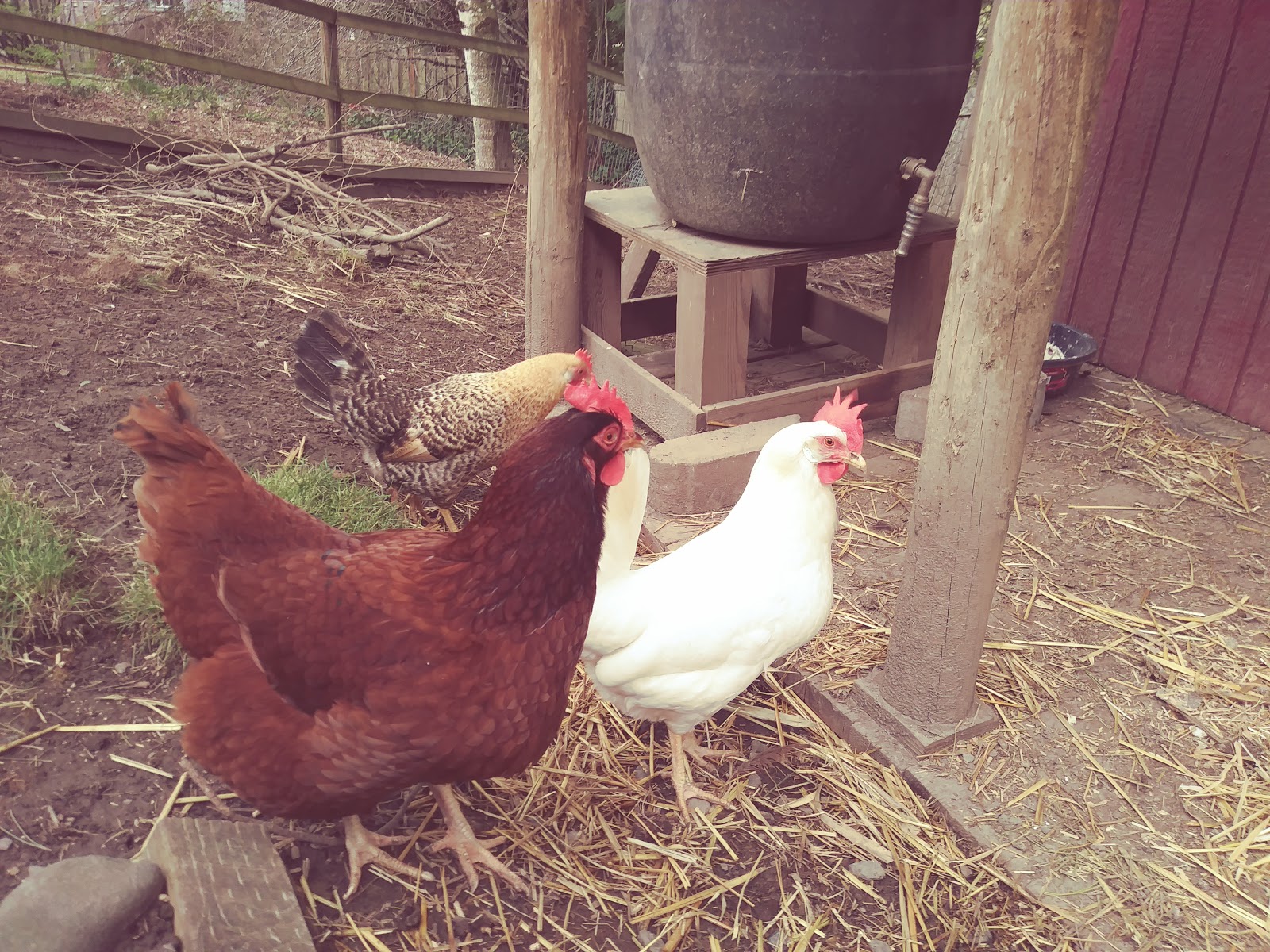
Hi Students! I've been grading IA's for 2nd year and it's driving me bananas, so here is a video of the growing chicks. Listen to their cute little peeps! Their grown up sisters are squawking in the background. I'll include a photo of them too, so you can see where all the noise is coming from. Apparently I was supposed to be paying more attention to them! Hope you all are hanging in there!
Good Morning Students! Here is today's video. In brief, what it says it to keep those 2.7 and 7.1 questions coming in, but you can forget the 2-3 paragraph response (I know that I said 2-3 pages by accident in my video!) to the epigenetics video and the dbq's. Stay tuned for some instructional videos on Transcription and Translation. Also, I said that we got 18 chicks, but it is actually 16, and they are so cute! Photo included below.
Review DNA Replication (notes and some videos are on my website
Finish 2.7 and 7.1 Questions in your notebook and email me a photo (mkenny@pps.net)
Read 7.2 and go over Transcription Notes
Watch "Epigenetics the Hidden Life of Our Genes" and the 8 minute clip from "Ghost in our Genes" . Write a 2-3 paragraph summary of what you learned about epigenetics and how it relates to transcription.
Do DBQs on pp 356 and 358 in 7.2. You can put the answers at the end of your 2-3 paragraph document. Submit both the paragraphs and dbqs to the assignment in turnitin.com by Friday 3/20
Read the transcription and translation sections of 2.7. I will put a genetic code worksheet on the website to work on.
Tues 3/10: Science State Testing. Thank you all for being so cooperative with this! I'm not sure how this will get finished in light of corona virus, but I'm assuming that extensions will be made and you will be pulled out to finish it later when we get back to school.
Thurs 3/12: Go over the Hershey-Chase experiment and notes on DNA Replication. Work on the 7.1 questions that I put on the website. Get checked off when you finish.
Mon 3/16: Review DNA replication. I have put several videos on this website to help you go over the process. Finish doing the 2.7 and 7.1 questions in your notes. You can email me a photo of this work and I will check it off. Read 7.2 and go over the Transcription Notes.
Wed 3/18: Watch the Video "Epigenetics: The Hidden Life of our Genes". It is 53 minutes. We used to show "Ghost in Your Genes" as the primary video on epigenetics and I have also included an 8 minute clip of that. Please watch these and write 2-3 paragraphs about how epigenetics works and how it relates to the topic of transcription. I would also like you to include answers to the 2 DBQs in 7.2 on twin studies. Please submit these to turnitin.com by Friday 3/20!
Fri 3/20: Read the transcription and translation sections of 2.7 (pp 116-122) and do the Genetic Code worksheet on my website. I will post a video to help you get started on this.
Moving forward: Read 7.3 and go through the Translation Notes. I will post videos to help with this material.
Tues 2/18: Notes on basic genetics, how to do a monohybrid cross with simple dominance and co-dominance. ABO blood group crosses. Dihybrid crosses and the multiplication rule. Work on the Old Book Genetics Problems (you can skip #6 for now). Do problems on separate paper that you can turn in. Show work and/or explain reasoning. Work can include Punnett grids, diagrams, and showing mathematical work. Read 3.4 if not already.
Thurs 2/20: Go over some of the genetics problems and introduce pedigrees. Sex-linked genes. More work time on genetics problems, to be turned in on Monday 2/24. Hand out pedigree worksheet. Start reading 10.2.
Mon 2/24: Turn in genetics problems. Check off pedigree worksheet. Notes on causes of genetic diseases and some common single gene disorders. Polygenic inheritance. Genetics of Race Video. Research a single-gene disorder, including where on the chromosomes it occurs, what it does to impact the body, symptoms, treatments, outcomes, interesting facts, etc.
Wed 2/26: Notes on linked genes, recombinants, calculating frequencies of recombination, and a little bit on gene mapping. Introduce chi-squared. Some DBQs to be done in your notebook: pp. 452-453 and p. 454 (chi-squared).
Fri 2/28: Chi-squared and flower activity. Answer questions in pairs and get checked off.. Read 10.2 if not already. Review for Genetics Test to be taken next Friday 3/6.
Tues 3/3: Counselors will be here to do a 30 minute presentation. Play Kahoot Review for Genetics Test.
Wed 3/4: SAT Testing Day. There will be a Full 8 schedule for those not taking the test.
Friday 3/6: Genetics Test. Start replication. Read the first part of 2.7 and 7.1.
Be able to describe all the phases of meiosis, in particular, make sure you understand the difference between Meiosis I and Meiosis II
Be able to identify phases of meiosis in simple diagrams or pictures
Be able to draw and label the stages of crossing over making clear the before, during, and after. I recommend 4 stages as they showed in the book in 10.1. Be able to distinguish between homologous chromosomes, sister chromatids, and nonsister chromatids.
Be able to describe the significance of independent assortment and how it adds to the variety of gametes.
Basic vocabulary involving genes and chromosomes. In addition you should be able to distinguish between genes, chromosomes, and genomes
Be able to describe how nondisjunction occurs and be able to describe two disorders caused by nondisjunction
Be able to discuss the 2 methods of obtaining fetal cells for karyograms, including how they are done, benefits, and risks.